Oven → air fryer

Air fryer calculator.
Keep the crisp.

Turn oven instructions into a practical air fryer starting point, with a check window that accounts for real-world variation.

°C and °F Fan oven aware No sign-up

Your oven recipe

Oven to air fryer converter

°C
min
Basket load

Crowded baskets need more time and still cook less evenly. Cook in batches when possible.

Air fryer starting point

Preheat if your appliance or recipe calls for it

Temperature 185°C
Cooking time 24 min
CheckStart checking at 20 minutes
TurnShake or turn at 12 minutes
RangeLikely window: 22–27 minutes

Use the result as a starting point. Check food early and follow your appliance manual.

Guidance, not a doneness guarantee
Try an example

Transparent method

No mystery formula.

The calculator uses a conservative rule of thumb, then adjusts the time for the source appliance and basket load. Food type changes the checking advice—not the answer just to look more precise.

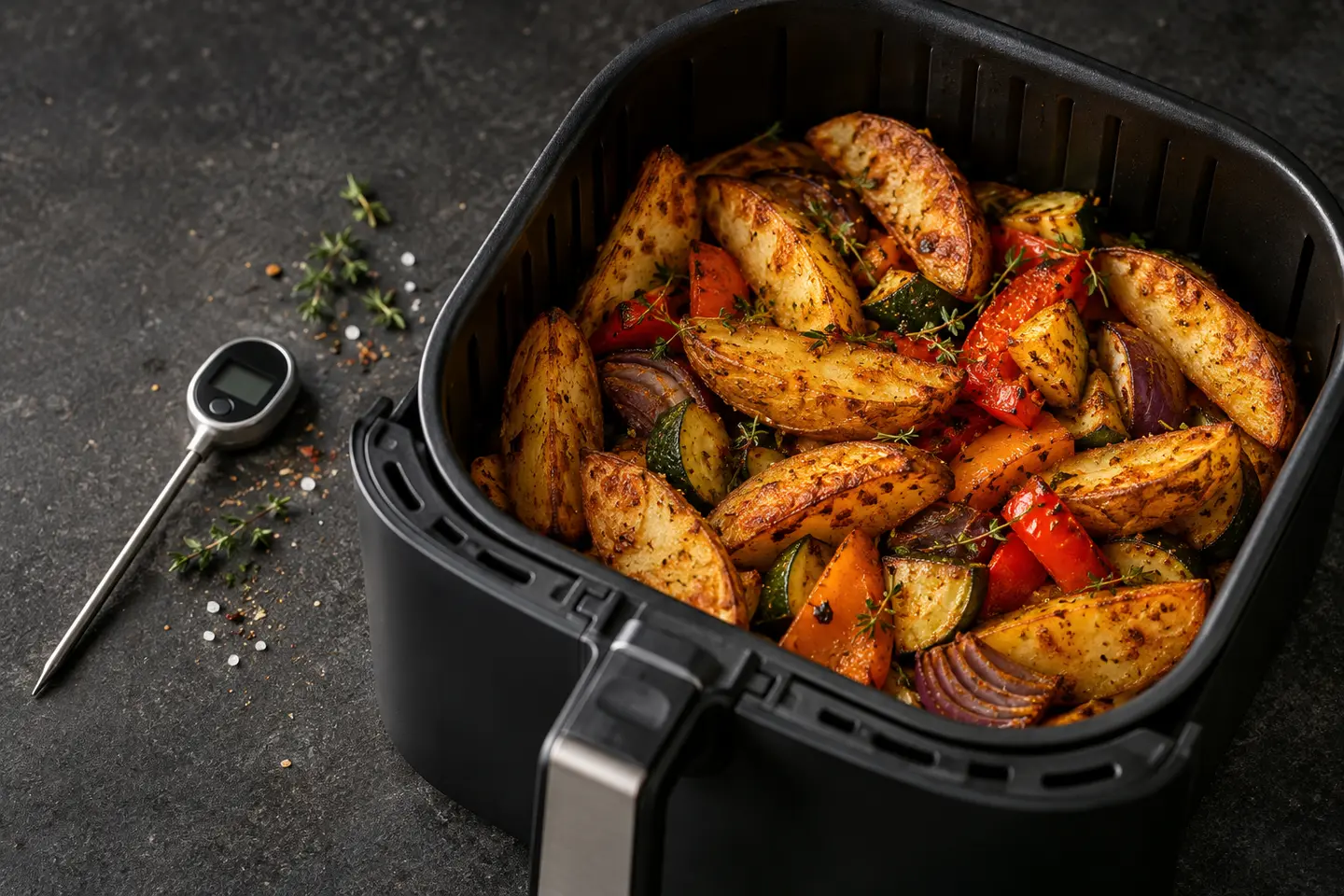
Crispy potato wedges and vegetables in an air fryer basket beside a food thermometer

Baseline conversion

Conventional oven to basket air fryer

Temperature−15°C
Cooking time× 0.80
  • Fan ovenSmaller change: −5°C / −10°F and about 10% less time.
  • Toaster ovenMiddle ground: −10°C / −15°F and about 15% less time.
  • Crowded basketAdds 8% to the starting time, but a single layer is more reliable.
  • Check windowStarts early because air fryer power, food size and starting temperature vary.

The physics of crisping

Why moving air changes the cook.

An air fryer does not change the chemistry of cooking. It changes how quickly heat and moisture move at the food's surface. The center still warms mainly by conduction, which is why thickness can matter more than total weight.

Surface heat transfer
conv = h · A · (Tair − Tsurface)

Faster forced airflow can increase the effective heat-transfer coefficient h. More exposed surface area A also helps, which is why a single layer generally browns more evenly than a crowded basket.

Heating the center
tcore ∝ L² / α

In a simplified conduction model, heating time rises with the square of characteristic thickness L. Doubling thickness can therefore change core-heating time far more than doubling weight spread across the basket.

heffective convective heat-transfer coefficient
Afood surface exposed to moving air
ΔTair-to-surface temperature difference
αthermal diffusivity of the food
01

Convection heats the surface

The fan continually replaces cooler, moisture-rich air near the food with hotter, drier air. The result is faster surface heating and evaporation than still air under otherwise similar conditions.

02

Evaporation creates the crust

Crisping depends on removing water from the outer layer. When pieces touch or the basket is crowded, escaping vapor has less room to disperse and browning becomes patchy.

03

The center follows more slowly

Airflow can make the outside look finished before a thick center is safe. Color is therefore a texture cue, not a reliable doneness test for poultry, meat, fish or reheated food.

Evidence, with limits

What research actually supports.

Laboratory results depend on the food, appliance, temperature and preparation. A potato study cannot validate a universal cooking-time formula, but it can explain why moisture, texture and browning behave differently.

Food Science & Nutrition2023

Forced-air frying changed moisture and texture

A controlled comparison of frozen potato strips reported greater weight loss, lower final moisture and higher measured hardness and fracturability for the air-fried samples under the study's specific conditions.

Limit: one potato product, one appliance and one cooking protocol. The result should not be generalized to every food.

Read the open-access study ↗
Frontiers in Nutrition2024

Air frying is not automatically acrylamide-free

One potato experiment reported no statistically significant difference between air, deep and oven frying, despite the highest mean value appearing in the air-fried group. A published commentary later challenged aspects of the measurements.

Practical implication: avoid excessive dark browning. Time, temperature, sugars and surface dryness all influence acrylamide formation in starchy foods.

USDA FSISFood safety

Temperature, not color, confirms safety

Use a food thermometer at the thickest point. The calculator estimates appliance settings; it cannot measure internal temperature or guarantee doneness.

  • Poultry & leftovers165°F / 74°C
  • Ground meats160°F / 71°C
  • Fish & shellfish145°F / 63°C
  • Whole cuts*145°F / 63°C
*Beef, pork, veal and lamb, followed by a 3-minute rest. USDA safe temperature chart ↗

Quick reference

Air fryer conversion chart

Common conventional oven settings converted with the baseline rule. Use the calculator above for fan ovens, toaster ovens and crowded baskets.

Conventional oven → basket air fryer

Oven tempOven timeAir fryer tempAir fryer time

Times are starting points. Verify doneness and use a food thermometer for meat, poultry, fish and reheated foods.

Why results vary

Three variables beat false precision.

Two air fryers set to the same temperature can finish at different times. The best result comes from a useful starting point plus an early check.

01

Airflow

A single layer exposes more surface to moving hot air. Stacking slows cooking and softens browning.

02

Food geometry

Thickness matters more than weight alone. Thin fries and a whole chicken do not scale by one formula.

03

Your appliance

Basket shape, wattage and thermostat behavior change how fast food browns and cooks through.

A better first cook

Calibrate the calculator to your air fryer.

The biggest source of future accuracy is not a more complicated universal formula. It is one controlled observation from your own appliance.

  1. 1

    Use a single layer

    Keep food size and spacing consistent so airflow is not the hidden variable.

  2. 2

    Start with the calculated setting

    Do not change time and temperature at once. Keep the starting point testable.

  3. 3

    Check at the early marker

    Measure internal temperature where relevant and note when texture is actually right.

  4. 4

    Record the difference

    If the food consistently finishes 3 minutes early, apply that correction next time for similar foods.

Watch and understand

Useful air fryer videos

Two visual explainers that go beyond recipe lists: one focuses on air-fryer heat transfer, while the other discusses acrylamide and the limits of simple health claims.

Videos are included for additional explanation, not as the scientific basis of the calculator. Use the linked studies and official safety chart for source material.

Straight answers

Air fryer conversion FAQs

How do I convert oven time to air fryer time?

Reduce conventional oven time by about 20% as a starting point. A 30-minute recipe becomes roughly 24 minutes. Begin checking before the end because small or thin foods may finish sooner.

How do I convert oven temperature to air fryer temperature?

For a conventional oven recipe, start about 25°F or 15°C lower. A 400°F recipe becomes about 375°F; a 200°C recipe becomes about 185°C.

Is the conversion the same for a fan oven?

No. Fan and convection ovens already circulate hot air, so the difference is smaller. The calculator uses a 10°F / 5°C reduction and shortens time by about 10%.

Should I preheat an air fryer?

Follow your appliance manual and recipe. Preheating often helps browning and baked foods, while some recipes are written for a cold start. Avoid adding the preheat time twice.

Why does my air fryer cook faster than the calculator says?

Wattage, basket size, food thickness, starting temperature and crowding all change cooking speed. Record what happened and adjust the next cook by a few minutes rather than changing everything at once.

What formula does the air fryer calculator use?

For a conventional oven, the baseline subtracts 25°F or 15°C and multiplies time by 0.80. Fan ovens use a smaller 10°F / 5°C reduction and a 0.90 time factor. Toaster ovens sit between the two. A crowded basket adds 8% to the estimated time.

Does air frying always produce less acrylamide?

No universal guarantee is supported. Results vary with the potato or grain product, reducing sugars, temperature, time, moisture and browning. Avoid excessive dark browning and treat broad “healthier” claims cautiously.

Can I use an air fryer instead of an oven for every recipe?

No. Wet batter, very large foods and delicate bakes may need a different method or work better in an oven. Never assume a time conversion proves that food is safe to eat.

Food safety: check internal temperature with a thermometer. Poultry and leftovers should reach 165°F / 74°C; whole cuts of beef, pork, veal and lamb need 145°F / 63°C plus a 3-minute rest.

USDA temperature chart ↗
Result copied